Friday, 18 March 2022

Privilege / Earned Leave Encashment


Privilege / Earned Leave Encashment

How it is calculated?

·         15 Days of PL can be encashed once in a block of 2 Calendar years eg. 2019-2020.

·         Basic, DA and CCA is included in salary for calculation. i.e. (Basic, DA and CCA)/30 for 15 Days.

·         It comes around Rs. 43,000.00 approx. for an Employee having Basic Salary of Rs. 50000 @ 70% DA applicable now.

Whether it should be claimed or not?

·         Generally 1 PL is being credited for 11 working days.

·         Around 270 Working Days are there in a year. 24-25 PL’s are credited every year. That means around 50 PL’s are credited in a Block.

·         After encashment of 15 leaves, you have 30-35 PL’s left to carry forward which can be availed in addition to other leaves like casual leaves.

·         Hence it can be claimed without compromising on the leaves.

When is the right time to claim it?

·         If claimed in Start of block and the amount is invested in FD @ 6%, Rs, 43000 becomes Rs. 47600 approx.

·         If claimed in End of block and eligible amount due to annual increment and revision in DA increases to Rs. 49000 approx. (On Average basis). Hence Claim at end of Block is beneficial.

·         However, Employees who have reached to maximum of their basic salary in their cadres or are near, then Increase in Basic Salary is less than interest that can be earned if availed in start of block. Hence Claim at start of Block is beneficial.

·         Those in Early years of job should claim it in end of the block and those in top bracket of their fitment charts of basic salary should claim in start of the block.

·         If anyone want to use it to adjust it in his/her financial goal/planning or want to use it for any other independent activity like holidays, then no need to think much on this. You can claim as and when required.

Note: Leaves Encashed are subject to Income Tax. Even then it should be claimed.

Monday, 14 March 2022

All India Consumer Price Index (IW) – Mar 2020


All India Consumer Price Index (IW) – Mar 2020

All India Consumer Price Index for Industrial Workers for March 2020


Base Year

Feb-20

Mar-20

Consumer Price Index Numbers for Industrial Workers - CPI(IW)

1960 = 100

7486

7441

2001 = 100

328

326


All India Consumer Price Index for Industrial Workers has been decreased by 2 points in March 2020 to 326 from 328 in February 2020

·         Consumer Price Indices (CPI) measure changes over time in general level of prices of goods and services that households acquire for the purpose of consumption.

·         CPI numbers are widely used as a macroeconomic indicator of inflation, as a tool by governments and central banks for inflation targeting and for monitoring price stability.

·         CPI is also used for indexing dearness allowance to employees for increase in prices.

·         CPI is therefore considered as one of the most important economic indicators.

·         Released by Ministry of Statistics & Programme Implementation

·         The items covered in the basket are divided into three main categories for the purpose of price collection depending upon the frequency of price collection namely weekly, monthly and half-yearly :

i).            The prices of some items such as cereals, pulses, oils and fats, meat, fish, condiments, vegetable etc. which are sensitive and change frequently, are collected on weekly basis.

ii).           Prices of items like cinema, furniture, utensils, clothing, house-hold appliances etc. are collected on monthly basis as their prices do not change very frequently.

iii).          The prices of items like house rent, school/college fees and books are collected once in six months.

·         An All-India index isa weighted average of 70 centresindices. These 70 centres are allocated to different states on the basis of proportion of industrial worker employment in them. The weight assigned to each centre is the proportion of the estimated consumer expenditure of the centre to the aggregate consumer expenditure of all the centres

All India Consumer Price Index (IW) – Feb 2020


 All India Consumer Price Index (IW) – Feb 2020

All India Consumer Price Index for Industrial Workers for February 2020


Base Year

Jan-20

Feb-20

Consumer Price Index Numbers for Industrial Workers - CPI(IW)

1960 = 100

7532

7486

2001 = 100

330

328


All India Consumer Price Index for Industrial Workers has been decreased by 2 points in February 2020 to 328 from 330 in January 2020

·         Consumer Price Indices (CPI) measure changes over time in general level of prices of goods and services that households acquire for the purpose of consumption.

·         CPI numbers are widely used as a macroeconomic indicator of inflation, as a tool by governments and central banks for inflation targeting and for monitoring price stability.

·         CPI is also used for indexing dearness allowance to employees for increase in prices.

·         CPI is therefore considered as one of the most important economic indicators.

·         Released by Ministry of Statistics & Programme Implementation

·         The items covered in the basket are divided into three main categories for the purpose of price collection depending upon the frequency of price collection namely weekly, monthly and half-yearly :

i).            The prices of some items such as cereals, pulses, oils and fats, meat, fish, condiments, vegetable etc. which are sensitive and change frequently, are collected on weekly basis.

ii).           Prices of items like cinema, furniture, utensils, clothing, house-hold appliances etc. are collected on monthly basis as their prices do not change very frequently.

iii).          The prices of items like house rent, school/college fees and books are collected once in six months.

·         An All-India index isa weighted average of 70 centresindices. These 70 centres are allocated to different states on the basis of proportion of industrial worker employment in them. The weight assigned to each centre is the proportion of the estimated consumer expenditure of the centre to the aggregate consumer expenditure of all the centres


Sunday, 13 March 2022

How to Calculate CAGR?


How to Calculate CAGR?

Compound Annual Growth Rate……….

1.       It helps to calculate annual growth rate of an investment over a specific period of time.

2.       It helps to determine Rate at which we have earned on an individual investment, assets and portfolio.

3.       CAGR is the best formulae to compare and determine how various investment options have performed against each other.

4.       Returns over a longer period of time are volatile and may be high in some period and may be negative in some period. Hence CAGR gives you an average rate over the total period under consideration.

5.       It is generally observed that various investment option has given ROI as mentioned below:

Current Account

0%

Saving Account

3.5%

Gold

5% - 6% (Last 5 year Avg.)

Real Estate

5% - 6% (Last 5 year Avg.)

Fixed Deposit

6% - 8%

Debt Mutual Funds

6% - 7%

Mutual Funds – Indirect Investing in Share Market

12% - 18%

Direct Investing in Share Market

18% - 24%


6.       Above mentioned returns have been observed considering Index only. It does not mean that all the investors have earned the same return from investing in the said assets. Some may have earned double the average return and some may have suffered losses too.

7.       It is very important that we should calculate return on our investment since timing of investment is very important. Since difference between double of average return and losses is created only due to different timings of the investment.

8.       Correct CAGR of our portfolio will help us in making correct decision regarding choice of assets and duration to invest considering our risk appetite, requirement.

Excel Formulae to Calculate CAGR

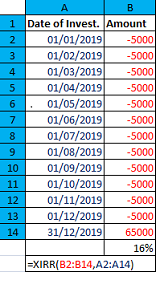
1.       Prepare 2 columns:

-          One column for Date of Investment where all dates are entered when you have made the payments (transaction wise)

-          Second for Amount, this is to be entered on corresponding to each date.  Negative values for payment and positive for receipt. Current value of investment can be used where amount is still invested.

2.       Use Formulae (=XIRR(B2:B14,A2:A14) where First range i.e. B2:B14 is for amount and second rage i.e. A2:A14 is for Dates.


3.       Refer image. In case of any doubt please comment

Abolition of Dividend Distribution Tax - Changes in Personal Income Tax in Budget 2020


Changes in Personal Income Tax in Budget 2020

Abolition of Dividend Distribution Tax

1.       Currently effective DDT rate is 20.56% on companies declaring Dividend.

2.       It is a major factor to cheer for some high dividend paying companies like TCS, Infosys, ITC, Vedanta, and many more since this step reduces the cost of doing business and remove the burden of compliance on dividend paying companies.

3.       Now Companies will either pay more dividends to investors or will use those funds to diversify their business.

4.       This DDT is over and above the corporate tax that companies pay on their taxable profit.

5.       As per current scenario DDT is charged equally to all individuals since companies have to pay the TAX at uniform rate. Effective rate is 20.56% irrespective of fact that beneficiary Individual is in 5% Tax Bracket or 30% Tax Bracket.

6.       From FY 2020-21, Dividend will be charged in the hands of recipient. Hence It is beneficial for those lying in lower Tax Bracket. Individuals in Higher Tax Bracket have to bear higher rate of tax.

7.       Now Dividend plans of mutual funds will not be that much beneficial to individual investors. So it is more beneficial to switch to growth option.

8.       Investors who require regular cash flows can shift to growth options with a systemic withdrawal plan (SWP). In which one can choose the date and amount of money they wish to withdraw every month.

9.       In growth Option and SWP, gain from units sold will be treated as Capital gains and Indexation is also available in case of LTCG and can enjoy lower tax rate.

10.   Investors whose income is not subject to tax could continue with the dividend option.


Market is Crashing…. Is it the Right time to Invest?


Market is Crashing…. Is it the Right time to Invest?

Stock Market is going down. All indices be it sensex, nifty and sector indexes are going down. Our Portfolio values are showing losses. Don’t Panic. It is the time to withdraw from Debt funds and to invest in the equity funds.

The most important thing now is to take precautions and utmost care to prevent us and our family from this deadly corona virus. When this corona virus deadly show will end stock market will also settle down. And then comes another life time opportunity to invest from where we can achieve higher returns.

Let us understand some natural phenomenon or behavior of the stock market:

-          In the Long Run, Market or economy of a country like India will definitely go up. And being a developing country growth rate is on higher side. Interest rates of deposits/loans in developed countries like USA ranges between 4-7% whereas it ranges between 6-10% like India.

-          As we all know nothing is permanent and constant. Change is the only thing which is constant.  Similarly Growth in the stock market or in our economy is also not constant.

-          It works in cycles of 4-7 years comprising of bullish run where everything is on rising trend and bearish run where everything is on declining trend like now.

-          This bearish trend is due to “Corona Virus”. In Past we have seen these trends various times due to various reasons.

-          Ups and Downs is a very natural phenomenon in the stock market. Every time it goes down it jumps back again and touches new highs.

-          As I have already shared this in my earlier post “Whento Invest in Stock Market?” that:

o   Generally PE Ratio of Nifty ranges between 10 – 30.

o   If NIFTY PE is around 10 to 15, then it is right time to Invest. Since Stocks are undervalued.

o   And If NIFTY PE is around 25 to 30, and then it is right time to Divest (encash the profits). Since Stocks are overvalued or we can say Share Values are at their Peak.

-          It was around 29 in the start of the year in “Jan 2020” when market was at its peak and now on 19th march 2020 it is 18.63.

-          May be it will go down further and settle around 12-15. Then you can say time has come to invest more funds.

What to Do and where to Invest?

-          Since stocks are currently available at very cheaper rates. It is the time to invest.

-          Invest in Share market either directly in shares or indirectly in Mutual Funds to achieve your long term goals.

-          Don’t follow the tip. Follow the trend. Don’t wait for tips to come. Spend some time and do some screening and research before investing your hard earned money.

-          How to select stocks to minimize risk:


a.       Blue Chip Stocks or we can say large cap stocks i.e. top 100 stocks in terms of market capitalization. These stocks have given consistent returns in the past and most probably will give in future also. Hence these are considered less risky. Now almost every stock is available at attractive valuations.

b.      Companies having nil or very low Debts. High Debt ratio means high risk.

c.       Companies which have shown profits on consistent basis and more important is growth in profits every year. Past years financials to be reviewed to check the consistency in the profits.

d.      Companies paying dividends on regular basis should also be considered.

Don’t follow the Herd Mentality. Follow value Investing.

Simple and Effective Secrets to earn higher returns in the Share Market


Simple and Effective Secrets to earn higher returns in the Share Market

I am writing below points considering those investors who want to invest for long duration to achieve above normal Return on funds saved from their hard earned money:

1.       We need to have patience. Don’t panic when market is down or is in declining trend. Since Ups and Down is a very common and regular feature of Share market depending upon various factors.

2.       Don’t follow the tip – Don’t take decision only on the basis of free advices we got here and there, but follow the Trend – Past track record of Index, Mutual fund, Asset Management Company of a MF, Particular Comapny.

3.       Diversification of investment is very important:

-          15-20% of portfolio should be invested in Debt Funds, Bank FD’s (Very Less Risky Assets)

-          Not More than 25-30% of portfolio should be invested in Small and Mid Cap shares/funds (High Risk Assets – High Volatility).

-          40-50% of portfolio should be invested in Large Cap/ Blue Chip Shares/Funds (Less Risky assets – Low Volatility).

4.       In Mutual Funds, Always opt for Direct Funds. Investing through broker / banks will charges you commission from the amount invested which can save you lakhs of rupees.

5.       In Mutual Funds, Growth option is recommended unless regular source of income is required for daily needs considering reinvestment of dividends earned and taxation impact.

6.       In the Long Run, Share market will definitely rise and that too at above normal Rate. In Last 20 year’s sensex has increased with annual rate of 12 – 15 %. Stay invested unless there is an urgent requirement.

7.       Market Price Earning Ratios generally ranges b/w 10-30.

-          When it is around 25-30 (Means Market are on higher side and shares may be overvalued), then we should divest from market if required since we get good prices for our shares.

-          When it is around 10-15 (Means Market is on lower side and shares are undervalued), then we should Invest in market if surplus amount is available for investment since we get shares in cheaper rates.

-          Please also read article on PE Ratio “What isthe Right Time to Invest in Share Market?


8.       Bull Run in the market means when Share prices in general are on increasing trend. This is the time when we should sell our shares/units if required.

9.       Bear run in the market means when prices in general are on declining trend. This is the time when we should buy shares/units (Addition to the investment) from the amount which is kept aside for investment.

10.   I don’t recommend SIP i.e. Systematic Investment Plan for investment in Equity Mutual Funds Since it averages the return due to the reason that it sometime buy at cheaper rates and sometime at expensive rates. And In my Opinion Lumpsum Amounts in MF Units should to be invested when market is down.  Meanwhile surplus Amounts can be invested in Debt Funds where there is no exit loads i.e. no charges on withdrawal.

Disclaimer – Share Market and Mutual Funds are subject to Market Risk. Please read the offer document carefully. Do thorough research before investing.  

What is the penalty for fake invoicing?

  What is the penalty for fake invoicing? Section 122:- Penalty for such Section 122 of CGST Act 2017: Penalty for Certain Offences (CHAPTER...